


10 Fascinating Cockroach Facts
Everyone has heard the catchy Spanish folk song, “La Cucaracha,” about a cockroach unable to walk because he has lost one of his six legs. While the song may be loved by children and fun to sing along to, it is highly unlikely that anyone feels the same affection for this ick-inspiring and disease-spreading pest!
Most homeowners are aware of the health and safety risks associated with cockroach infestations, including the allergies and asthma triggered by cockroach allergens, and the germs and bacteria they have been known to spread. What may not be as widely known is the fact that cockroaches are a very interesting and resilient pest that exhibits some very odd behavior and survival tactics. For example, cockroaches spend 75% of their time resting and can withstand temperatures as cold as 32 degrees Fahrenheit.
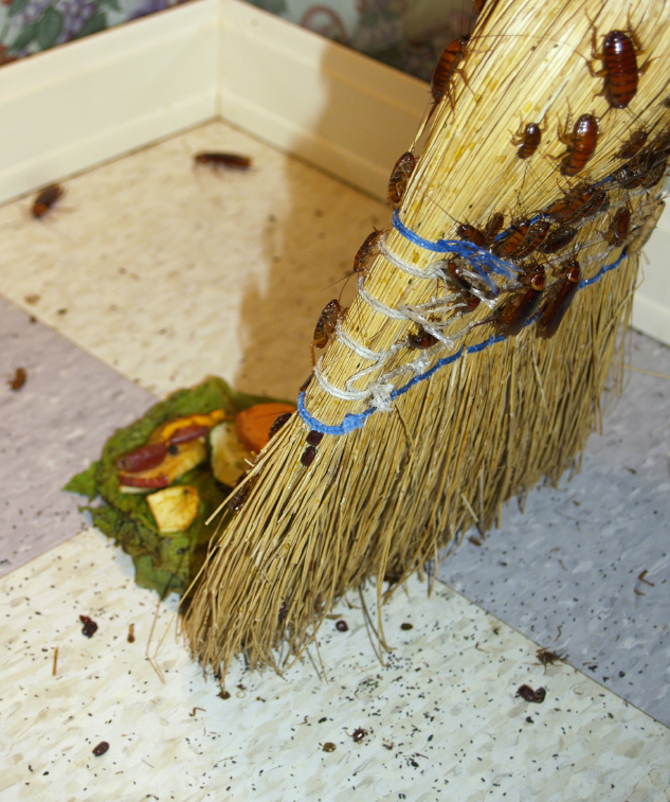
Here are ten of the most fascinating cockroach facts:
- A cockroach can live for a week without its head. Due to their open circulatory system, and the fact that they breathe through little holes in each of their body segments, they are not dependent on the mouth or head to breathe. The roach only dies because without a mouth, it can’t drink water and dies of thirst.
- A cockroach can hold its breath for 40 minutes, and can even survive being submerged under water for half an hour. They hold their breath often to help regulate their loss of water.
- Cockroaches can run up to three miles in an hour, which means they can spread germs and bacteria throughout a home very quickly.
- Newborn German cockroaches become adults in as little as 36 days. In fact, the German cockroach is the most common of the cockroaches and has been implicated in outbreaks of illness and allergic reactions in many people.
- A one-day-old baby cockroach, which is about the size of a speck of dust, can run almost as fast as its parents.
- The American cockroach has shown a marked attraction to alcoholic beverages, especially beer. They are most likely attracted by the alcohol mixed with hops and sugar.
- The world’s largest roach (which lives in South America) is six inches long with a one-foot wingspan. Average cockroaches can vary in size from ½”- 2″ long.
- Cockroaches are believed to have originated more than 280 million years ago, in the Carboniferous era.
- There are more than 4,000 species of cockroaches worldwide, including the most common species, the German cockroach, in addition to other common species, the brownbanded cockroach and American cockroach.
- Because they are cold-blooded insects, cockroaches can live without food for one month, but will only survive one week without water.
These facts prove that cockroaches are some of the most adaptable creatures on earth, which makes controlling and eliminating a cockroach infestation all the more difficult. To get rid of cockroaches in your home, experts suggest keeping food sealed and stored properly, particularly in the kitchen, which should be cleaned daily to prevent crumbs and trash from building up. Garbage should be disposed of regularly and stored in sealed containers. Homeowners should seek out and seal all cracks and holes in homes, including entry points for utilities and pipes, as these can serve as entranceways for the pest. In addition, basements and crawl spaces should be kept well ventilated and dry.
Cockroach control and management are important for health and safety reasons. If you suspect a cockroach infestation, use our zip code locator to find a licensed pest control professional in your area.
Cockroach Genome Shows Why They Are Impossible to Kill
The massive genome includes code for neutralizing toxins, regrowing limbs and a thousand genes for detecting food and chemicals
/https://public-media.si-cdn.com/filer/e0/03/e0038b0f-7e69-45fc-9da8-8582f040aa1c/american_roach.jpg)
No matter how you feel about them, cockroaches are something special. Cut a few legs off a nymph, and they grow back. Leave a few cookie crumbs in the carpet, and the critters seem to instantly zero in on them. Expose them to fecal material, bacteria and other pathogens, homemade antibiotics will keep them healthy. On top of it all, they can eat just about anything, live in brutal conditions and laugh in the face of the toughest insecticides.
So what gives them these seeming superpowers? As Maggie Fox at NBC News reports, a new study suggests the answer is in their genes. Researchers at the Chinese Academy of Sciences in Shanghai sequenced the genome of the American cockroach, Periplaneta Americana, revealing a Swiss army knife-like set of genes that makes the insects uber adaptable.
It turns out that cockroaches have a massive genome; of the insects yet studied, the cockroach is second only to the locust. The genes of the American cockroach—which isn’t really American: it was likely transported to the Americas from Africa as early as 1625—is more closely related to termites than to the German cockroach, another major house pest that had its genome sequenced earlier this year. That’s not surprising, since termites turn out to be “eusocial cockroaches” and were moved into the same order as roaches earlier this year.
GenomeWeb reports that 60 percent of the cockroach’s genome contains repetitive elements. But it also includes 21,336 protein-encoding genes, 95 percent of which actually produce proteins. Many of those genes give cockroaches the tools to survive in urban environments. For instance, the cockroach has over 1,000 genes that code for chemical receptors that help them navigate the environment, including 154 olfactory receptors—twice as many as the other creepy-crawlies in its insect order—that allow them to pinpoint the burrito bits you dropped. It also has 522 gustatory receptors, with many of them able to detect bitterness, which may help them tolerate potentially toxic foods. The bugs also encode for certain enzymes that can help them resist pesticides and survive extreme environments.
Fox reports that during its nymph stage, the cockroach is also capable of regeneration. This special skill is the main reason behind its Chinese nickname, xiao qiang, which means little mighty one, the researchers write in their paper in the journal Nature Communications. “It’s a tiny pest, but has very strong vitality,” lead author Sheng Li tells Steph Yin at The New York Times.
The research has several applications. For instance, knowing how the roaches are able to cope with insecticides could lead to better roach control. “The harm of American cockroaches is becoming more serious with the threat of global warming,” the authors write. “Our study may shed light on both controlling and making use of this insect.”
Li also tells Yin that his team hopes to look at the potential healing properties of cockroaches. In traditional Chinese medicine, cockroaches are ground up and used for all manner of treatments thanks to its regenerative power. The team hopes to uncover the “growth factor” that makes that particular trick possible. “We’ve uncovered the secret of why people call it ‘xiao qiang,’” Li says. “Now we want to know the secrets of Chinese medicine.”
In recent years, researchers have uncovered a lot we wish we didn’t know about cockroaches. For instance, researchers have found that gut bacteria infuse roach poo with chemical cues that cause them to congregate. In other words, they like the smell of each other’s poop. Another study has shown that cockroaches have evolved to avoid the sugary baits that used to work on the pests in the 1980s and 1990s. Hopefully this latest study and future work will help scientists find a new remedy for—or another use of—the often despised but always durable cockroach.


The cockroaches that plague our homes are even more indestructible than we thought, according to a recent study by researchers at Purdue University in Indiana. The bug scientists used a variety of strategies and different insecticides to root out real-life infestations of the German cockroach (Blattella germanica), but found that the roaches were able to survive nearly all of their efforts.
What’s worse, their research suggests that these roaches can quickly develop resistance to more than one insecticide at the same time—a feat we didn’t know they were capable of.
German cockroaches are one of many insects that have steadily learned to fend off the chemical weapons we use against them. That’s forced exterminators and entomologists alike to scramble for new strategies to control home infestations. These have included periodically rotating the classes of insecticides for a pest treatment, combining multiple insecticides, and relying more on gel baits rather than sprays.
The team behind this study, published in June in Scientific Reports, decided to compare three of these strategies in the real world. At three roach-infested apartment complexes in Illinois and Indiana, they either used a rotation of three professional-grade insecticides, rotating every month for six months; sprayed two insecticides at the same time monthly; or laid down monthly gel baits with an insecticide that the roaches were previously shown to be susceptible to. The roaches in these homes had earlier been found to have at least some resistance to nearly all classes of insecticides.
The only method that put a significant dent in the roach population, they found, was the gel bait. The roaches laughed off the combination insecticides and even started to spread to new homes, while their numbers were unaffected by the rotation method. And the gel bait trick only worked because the roaches were especially vulnerable to it; in areas where only 10 percent of the population was resistant to the specific chemical used, the population again flourished.
Roach resistance is nothing new, but the researchers were surprised by their ability to foster as much “cross-resistance” as they did. Cross resistance is when surviving roaches exposed to one insecticide are then able to better resist a different insecticide. But while scientists have documented cross resistance in German cockroaches in the lab, these roaches were able to cross-resist a variety of insecticides across different classes to a degree not documented before, according to the paper. And that’s really bad news for the future of roach eradication.
“This is a previously unrealized challenge in cockroaches,” lead author Michael Scharf said in a release from Purdue University. “Cockroaches developing resistance to multiple classes of insecticides at once will make controlling these pests almost impossible with chemicals alone.”
Not all hope is lost, though. Scharf and his team were able to successfully combat the infestations left behind after the study was over with a rotation method using gel baits. And if people can first nail down the exact chemicals roaches in a particular infestation are resistant to, then it’s possible to find the right mix of insecticides to manage it. Non-chemical methods, like keeping food secure, repairing cracks where roaches get in, and vacuuming up large infestations, can also increase the chances of success.
“Some of these methods are more expensive than using only insecticides, but if those insecticides aren’t going to control or eliminate a population, you’re just throwing money away,” Scharf said. “Combining several methods will be the most effective way to eliminate cockroaches.”
Unfortunately, being able to afford these treatments is a major hurdle for the disadvantaged people most affected by household pests like roaches and bed bugs. It’s likely humans will be plagued by these insects for centuries to come.